


 Contact Now
Send Message
Privacy statement: Your privacy is very important to Us. Our company promises not to disclose your personal information to any external company with out your explicit permission.

Shaanxi Kaishi Biotechnology Co., Ltd


Product Description
Kale powder is a concentrated vegetable ingredient produced from kale leaves, Brassica oleracea var. sabellica, and used to add naturally occurring plant nutrients, color, and vegetable solids to food, beverage, superfood, and supplement formulations. Freeze-dried grades are especially suitable for buyers prioritizing nutrient retention, clean-label positioning, and premium product development.
Made from fresh kale through controlled drying and milling, kale powder provides a convenient alternative to handling fresh vegetables in commercial formulations. It can be incorporated into green powders, smoothie mixes, tablets, capsules, functional foods, nutrition bars, instant beverage blends, and other vegetable-based products.
Kale is a leafy vegetable in the Brassicaceae family and naturally contains chlorophyll, carotenoids, polyphenols, vitamins, minerals, and dietary fiber. Kale powder converts the fresh vegetable into a stable, concentrated dry format that is easier to transport, store, formulate, and dose in commercial products.
Unlike a single-compound standardized botanical extract, whole kale powder does not have one universal active-marker assay such as 50% or 99%. For procurement, the more meaningful specifications are raw-material identity, drying method, moisture, particle size, color, microbiological quality, heavy metals, and whether carriers or processing aids are used.
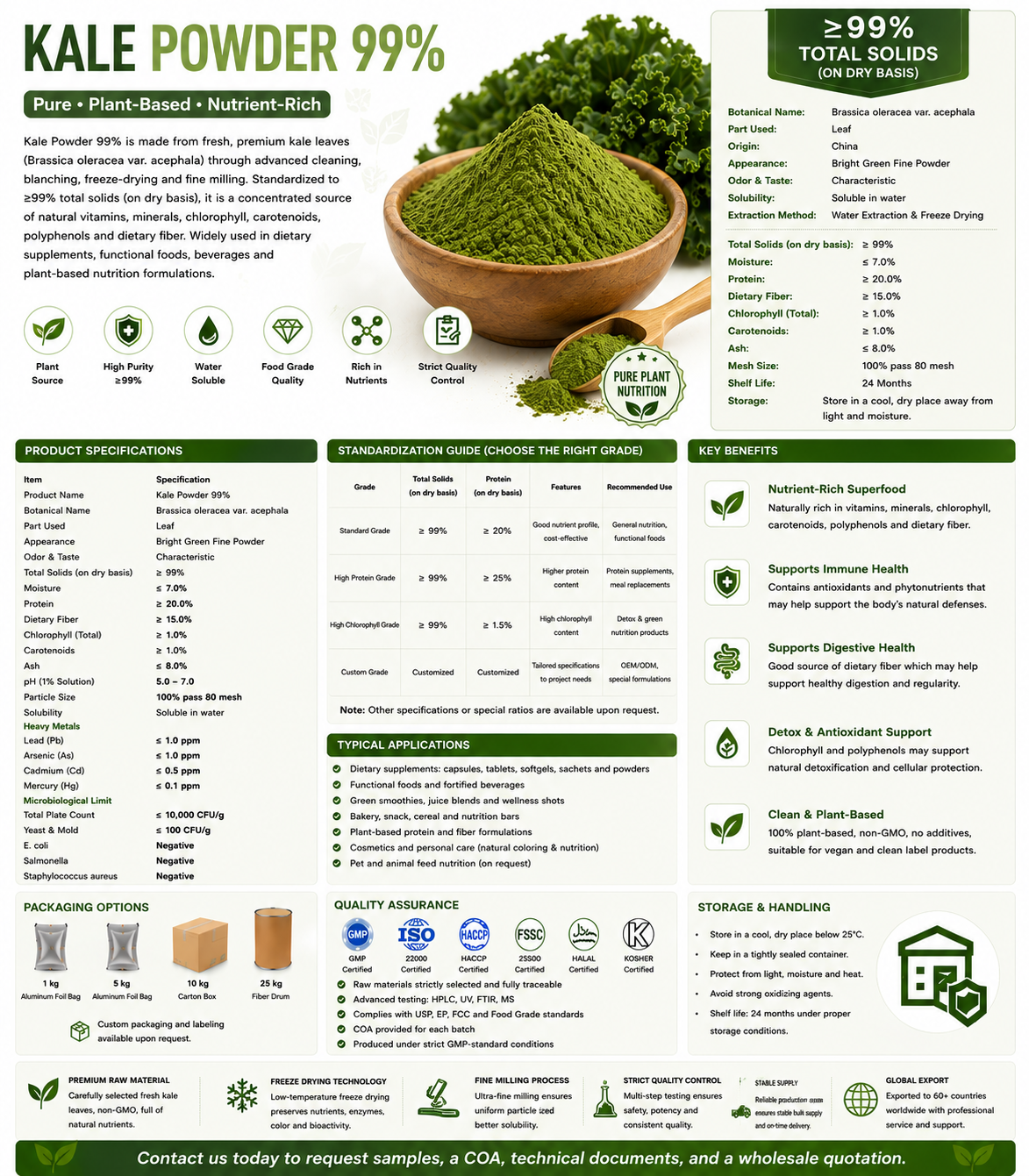
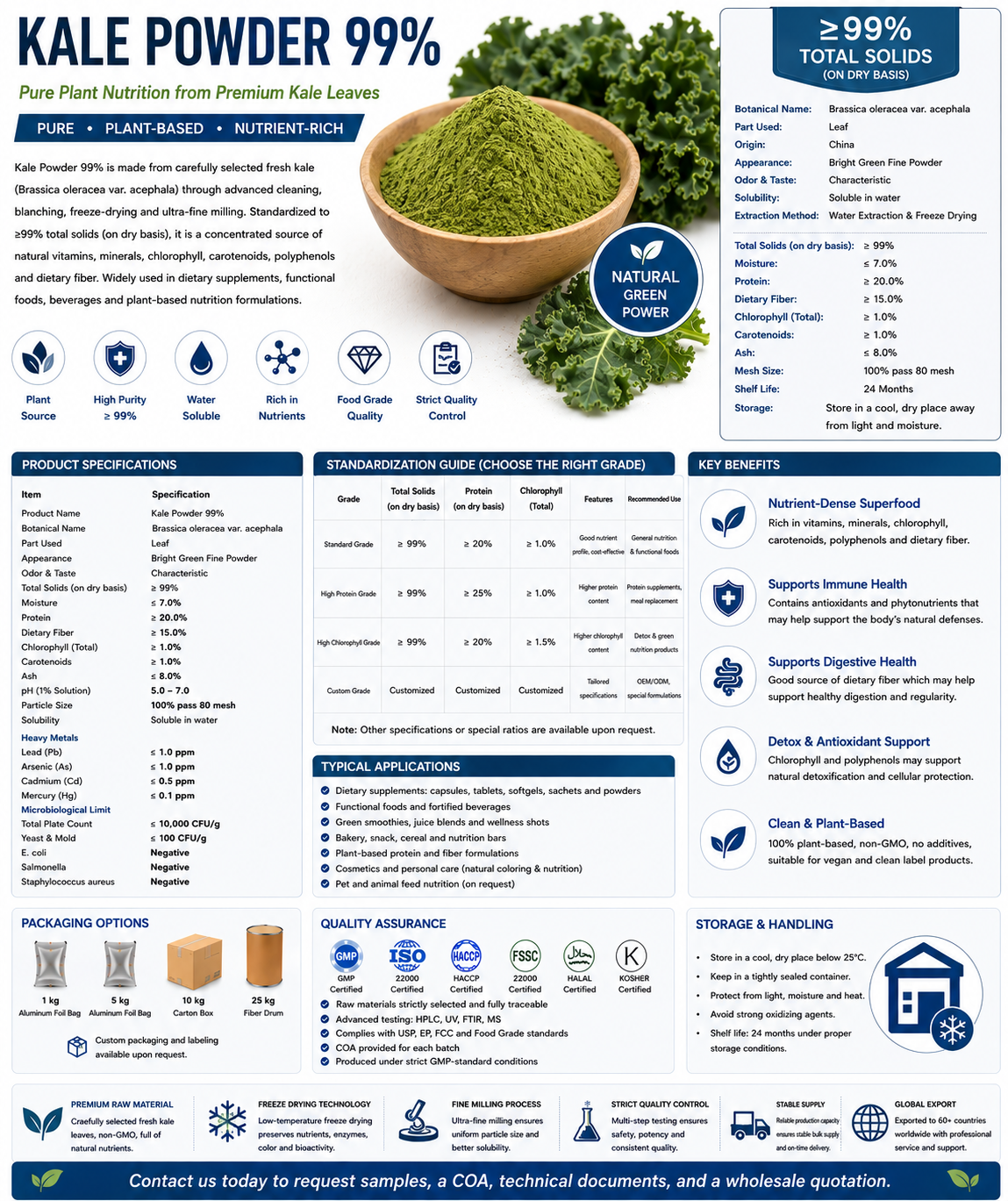
| Item | Specification |
|---|---|
| Product Name | Kale Powder |
| Botanical Source | Brassica oleracea var. sabellica |
| Plant Part | Leaf |
| Product Category | Superfood Powder / Vegetable Powder |
| Processing Method | Freeze-dried or other controlled low-temperature drying options according to formulation requirements |
| Appearance | Fine green to dark green powder with characteristic kale odor and taste |
| Assay | Whole-food vegetable powder; no single universal active-marker assay applies |
| Identity Test | Botanical identity and organoleptic verification; analytical testing applied as appropriate |
| Particle Size | Fine powder; particle size can be customized for beverage, food, capsule, and tablet applications |
| Moisture | Controlled to maintain powder stability and suitable commercial handling |
| Solubility | Dispersible rather than completely water-soluble due to naturally occurring vegetable solids and fiber |
| Carrier | Pure and carrier-assisted processing options can be selected according to product and application requirements |
| CAS Number | Not applicable to whole kale powder; it is a botanical food material rather than a single chemical compound |
| Molecular Formula | Not applicable to a multi-component botanical powder |
| Molecular Weight | Not applicable to a multi-component botanical powder |
| Quality Testing | Identity, moisture, heavy metals, microbiological parameters, and other applicable quality indicators |
| Shelf Life | Typically 24 months in unopened original packaging under recommended storage conditions |
| Storage | Store sealed in a cool, dry place away from direct sunlight, heat, and moisture |
| Packaging | 1 kg and 5 kg aluminum foil bags; 25 kg fiber drums; custom bulk and retail packaging available |
Drying method is one of the most important purchasing decisions for kale powder because buyers are sourcing a whole-food matrix rather than a purified chemical. Processing influences color, flavor, dispersibility, cost, and retention of heat-sensitive vegetable components. The best grade therefore depends on the finished product rather than on a headline purity percentage.
| Selection Factor | Freeze-Dried Kale Powder | Conventional Dried Kale Powder |
|---|---|---|
| Processing | Water is removed at low temperature under vacuum after freezing | Uses a conventional controlled drying process |
| Color | Generally better suited to formulations seeking a vivid natural green appearance | Color may be darker depending on processing conditions |
| Heat-Sensitive Components | Preferred when minimizing thermal exposure is a formulation priority | Suitable when processing economy and general vegetable nutrition are priorities |
| Flavor Profile | Suitable for premium green blends where characteristic vegetable flavor and freshness are important | Suitable for broad food and supplement applications |
| Cost Position | Typically higher because freeze-drying is more energy- and process-intensive | Typically more economical for volume formulations |
| Typical Application | Premium superfood powders, smoothie blends, nutrition mixes, capsules | Functional foods, tablets, capsules, food blends, economical green formulations |
For a premium green drink or superfood blend, freeze-dried kale powder is often selected for its low-temperature processing and attractive color. For capsules, tablets, bakery products, or cost-sensitive blends, conventional dried material may offer a more practical balance between functionality and ingredient cost.
Kale powder can be combined with spinach, wheatgrass, barley grass, spirulina, chlorella, fruit powders, and other plant ingredients in daily greens and superfood formulations. Freeze-dried material is particularly useful when the formulation is positioned around premium vegetable ingredients and minimal thermal processing.
The powder can be incorporated into smoothie mixes, instant nutrition powders, meal-replacement blends, and powdered beverages. Because whole kale contains insoluble plant solids, formulators should evaluate dispersion, sedimentation, mouthfeel, and particle size rather than expecting the complete clarity associated with a water-soluble extract.
Fine kale powder is suitable for vegetable capsules, tablets, and multi-ingredient supplement blends. Powder flow, bulk density, particle size, and moisture should be evaluated during scale-up because these physical characteristics influence filling efficiency and tablet processing.
Kale powder can be used in nutrition bars, vegetable snacks, pasta, bakery formulations, seasoning blends, soups, and other foods where vegetable solids and natural green characteristics are desirable. Formulators should consider the effect of processing temperature and the characteristic kale flavor on the finished product.
Choose by application rather than by an artificial purity claim. A label such as “99% kale powder” should not be interpreted in the same way as a 99% purified chemical active. For whole vegetable powders, buyers should establish what the percentage represents and review the actual specification, ingredient composition, processing method, and carrier declaration.
Consistent vegetable powder requires control of both the botanical raw material and the finished dry powder. Commercial batches can be evaluated through a combination of identity, physical, chemical, and microbiological testing.
The product is designed for commercial food, beverage, superfood, and supplement development rather than simply being positioned by an arbitrary purity number. Freeze-dried and conventional processing options allow formulators to balance color, processing intensity, application performance, and cost. Standard and customized specifications support different finished-product requirements.
Production under GMP-standard conditions, in-house R&D and testing capabilities, per-batch quality control, stable bulk supply, third-party testing options, technical documentation, and global export experience support procurement teams that require consistent commercial ingredient sourcing.
Standard bulk packaging includes 1 kg and 5 kg aluminum foil bags and 25 kg fiber drums with protective inner packaging. Custom packaging can be arranged for different order volumes and downstream production requirements. Samples and bulk quantities are supported for formulation evaluation and commercial procurement.
Kale powder can also be incorporated into customized finished products, including green powder blends, beverage powders, capsules, tablets, and other nutritional formats. OEM and private label services can cover ingredient selection, formula development, blending, finished-product manufacturing, labeling, and flexible packaging according to project requirements and applicable target-market guidelines.
It depends on the formulation. Freeze-drying minimizes high-temperature exposure and is commonly selected when color, premium positioning, and retention of heat-sensitive components are priorities. Conventional drying can be more economical for high-volume foods and supplements where processing cost is more important than the advantages associated with freeze-drying.
No. Whole kale powder contains naturally occurring fiber and other insoluble vegetable solids, so it disperses in water rather than dissolving completely. For beverage development, particle size, mixing conditions, suspension stability, and expected mouthfeel should be considered when selecting the specification and designing the finished formulation.
Buyers should review ingredient composition, carrier declaration, botanical identity, drying method, moisture, particle size, microbiological limits, heavy metals, and batch documentation. Whole kale powder is a complex food material, so a percentage claim does not represent chemical purity in the same way that it does for an isolated standardized compound.
A commercial buyer should normally review the batch COA together with the product specification or TDS and applicable safety documentation. Incoming inspection can then verify identity, appearance, moisture, microbiological parameters, heavy metals, and other agreed specifications according to the buyer's quality system and intended market.
Kale powder is a versatile vegetable ingredient for superfood blends, functional beverages, supplements, and food formulations. Selecting the appropriate drying method, particle characteristics, composition, and quality specification is more meaningful than relying on a simple purity claim. Contact us today to request samples, a COA, technical documents, and a wholesale quotation for kale powder.
Packaging & Delivery
The file is encrypted. Please fill in the following information to continue accessing it


Privacy statement: Your privacy is very important to Us. Our company promises not to disclose your personal information to any external company with out your explicit permission.
Fill in more information so that we can get in touch with you faster
Privacy statement: Your privacy is very important to Us. Our company promises not to disclose your personal information to any external company with out your explicit permission.