


Send Message
Privacy statement: Your privacy is very important to Us. Our company promises not to disclose your personal information to any external company with out your explicit permission.

Shaanxi Kaishi Biotechnology Co., Ltd
USD 55 - 65 / Others
Product Overview Tiamulin fumarate is a pleuromutilin-class veterinary active pharmaceutical ingredient (API) used in animal health formulations for livestock and poultry applications. It is supplied as a high-purity powder for veterinary...
USD 55 - 65 / Others
Product Overview Tiamulin is a pleuromutilin-class antimicrobial active ingredient widely used in veterinary pharmaceutical formulations. It is supplied as a high-purity API powder for qualified manufacturers developing animal health products,...
USD 50 - 60 / Others
Product Overview Meloxicam is a synthetic non-steroidal anti-inflammatory compound widely used as an active pharmaceutical ingredient (API) in veterinary and pharmaceutical formulations. It is supplied as a high-purity crystalline powder for...
Probiotic & Enzyme For Animals includes probiotic microorganisms and enzyme preparations intended for professional animal nutrition and feed formulation applications. Although these products may be used in related formulations, probiotics and enzymes have different identities, specifications, stability considerations, and quality-evaluation methods.
Animal probiotic products should be identified by their microorganism, strain designation where available, viable-count specification, test method, carrier system, physical form, and intended animal application. Products may be supplied as single-strain preparations or defined combinations of microorganisms.
A general description such as probiotic powder or beneficial bacteria does not provide enough information for product comparison. Buyers should confirm whether the declared count refers to the time of manufacture or the end of shelf life and whether it is expressed per gram or per unit of the supplied product.
Enzyme preparations should be identified by enzyme type, biological source, activity specification, activity unit, assay method, carrier composition, physical form, and intended substrate or feed application. Products may contain a single enzyme or a documented combination of enzyme activities.
Enzyme-activity values should be reviewed together with the applicable test method and assay conditions. Activity values generated using different methods or substrates may not be directly comparable, even when the same unit symbol is used.
For probiotics, buyers should review the microorganism identity, strain information, viable count, test method, carrier, storage requirements, shelf life, and available analytical documentation. For enzymes, buyers should review the enzyme identity, activity specification, assay method, carrier, stability, working conditions, and intended application.
The target animal species, life stage, feed format, inclusion purpose, processing conditions, packaging, and destination market should also be identified before product evaluation. Suitability for one species or feed system should not be assumed to establish suitability for another.
Probiotic viability can be affected by moisture, temperature, oxygen, storage time, packaging, and interaction with other formulation components. Feed processing, particularly elevated temperatures and moisture during pelleting, may reduce the viable count of sensitive microorganisms.
Enzyme stability may be affected by temperature, moisture, pH, storage, processing conditions, inhibitors, and interaction with other ingredients. Heat stability and retained activity should be evaluated according to the intended feed-manufacturing process and product format.
Regulatory status depends on the microorganism or enzyme identity, production strain, manufacturing process, composition, intended species, feed category, use level, labeling, and destination market. A microorganism or enzyme permitted in one market or animal application may be treated differently in another.
Buyers should verify feed authorization, strain or enzyme eligibility, labeling, safety, documentation, and application requirements before formulation, import, distribution, or commercial use. Inclusion in this category does not establish approval for every species, feed, dosage level, or market.
This category is intended for products supported by identifiable probiotic strains and viable-count specifications or by identifiable enzymes and enzyme-activity specifications. Products without this minimum identity and specification information should be reviewed before classification.
Veterinary Pharmaceutical APIs, antibiotics, disinfectants, ordinary yeast powders, fermentation extracts, botanical ingredients, finished veterinary medicines, and products promoted only with general digestive or growth claims should remain outside this category.
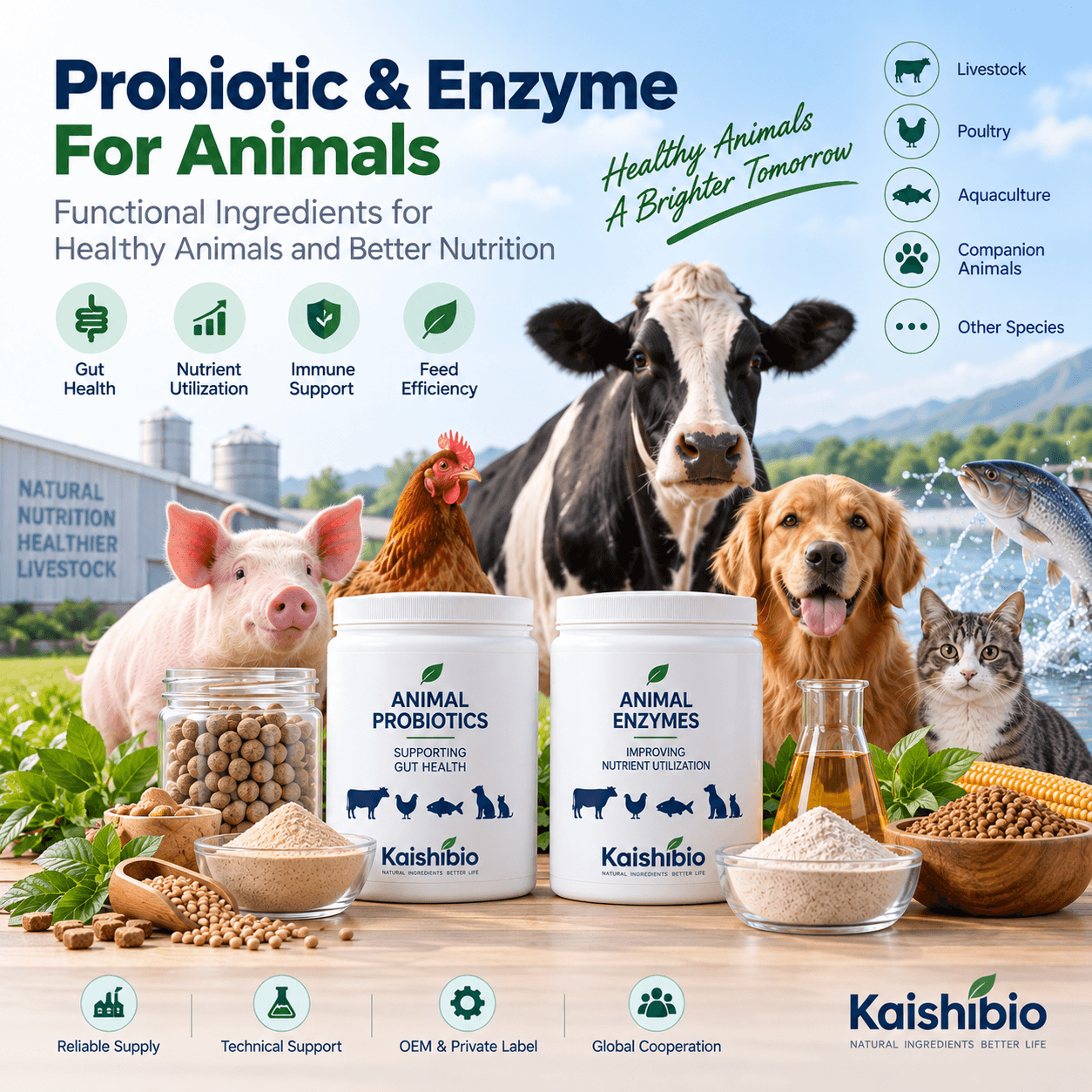
Probiotic & Enzyme For Animals
Privacy statement: Your privacy is very important to Us. Our company promises not to disclose your personal information to any external company with out your explicit permission.
Fill in more information so that we can get in touch with you faster
Privacy statement: Your privacy is very important to Us. Our company promises not to disclose your personal information to any external company with out your explicit permission.