


 Contact Now
Send Message
Privacy statement: Your privacy is very important to Us. Our company promises not to disclose your personal information to any external company with out your explicit permission.

Shaanxi Kaishi Biotechnology Co., Ltd


Product Description
Apple powder is a fruit ingredient produced from apples, Malus domestica, and used to provide natural apple flavor, fruit solids, carbohydrates, and characteristic fruit components in food, beverage, nutrition, and superfood formulations. Freeze-dried apple powder is particularly suitable for premium products where low-temperature processing, flavor retention, and clean-label positioning are important.
Commercial apple powder converts fresh apple into a stable, easy-to-handle dry ingredient for powdered beverages, smoothies, bakery products, nutrition bars, fruit blends, confectionery, dairy applications, and supplement formulations. Freeze-drying minimizes thermal exposure, while particle size and carrier selection can be adjusted according to the intended processing and formulation requirements.
Freeze-dried apple powder is manufactured by freezing prepared apple material and removing water under vacuum before milling the dried material into powder. Compared with higher-temperature drying processes, freeze-drying is commonly selected when preserving characteristic fruit color, aroma, flavor, and heat-sensitive components is an important product-development consideration.
Apple is a complex fruit material rather than a single purified compound. Therefore, whole apple powder does not have a meaningful universal chemical purity specification such as 98% or 99%. Professional sourcing should focus on fruit composition, processing method, carrier declaration, moisture, particle characteristics, sensory quality, microbiological limits, and heavy metals.
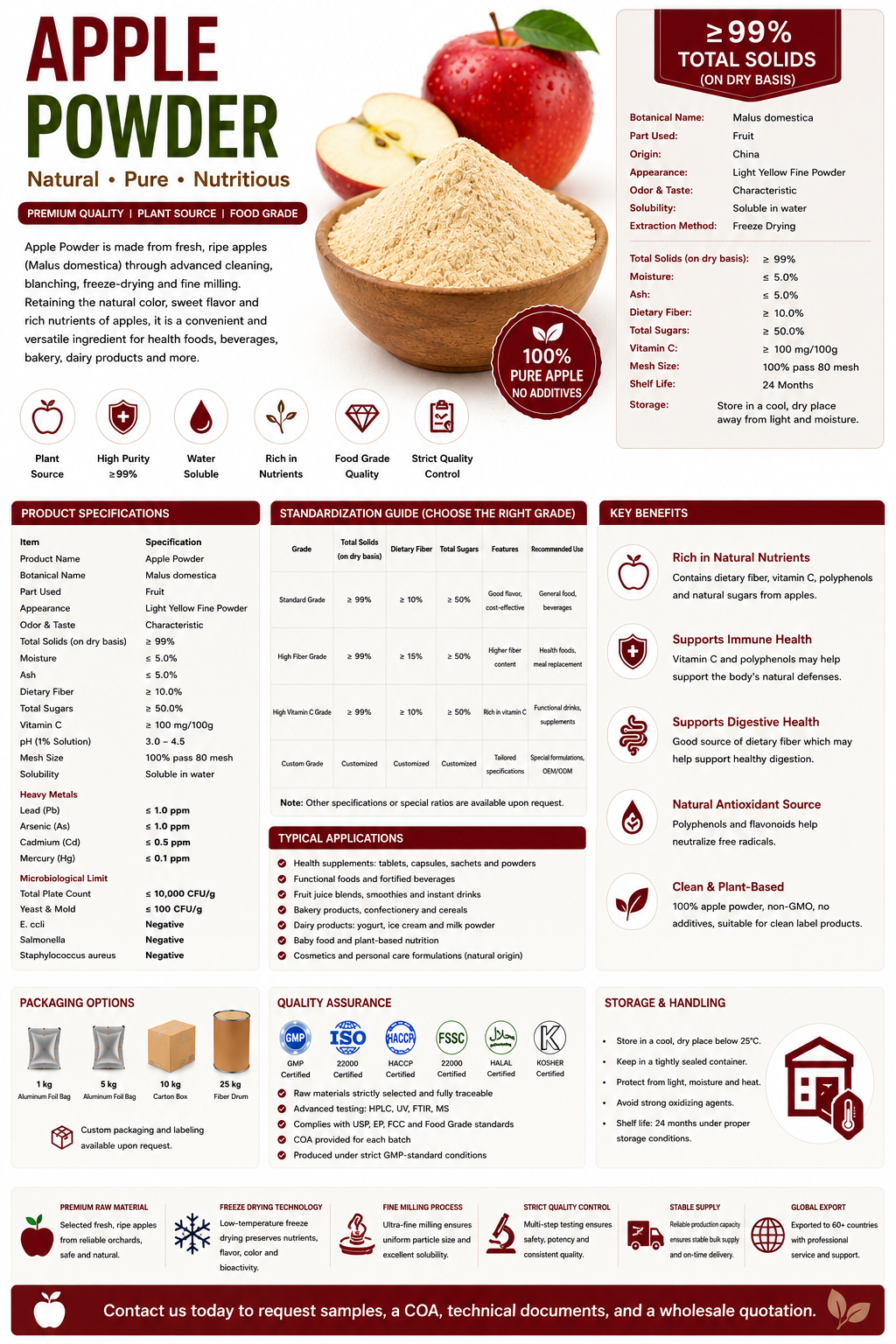
| Item | Specification |
|---|---|
| Product Name | Apple Powder |
| Botanical Source | Malus domestica |
| Plant Part | Fruit |
| Product Category | Superfood Powder / Fruit Powder |
| Processing Method | Freeze-drying with milling; other controlled drying options can be selected according to application |
| Appearance | Fine off-white, cream to light yellow-brown powder with characteristic apple aroma and flavor |
| Assay | Whole-fruit powder; no single universal active-marker assay applies |
| Identity | Botanical and organoleptic identity verification with appropriate analytical quality testing |
| Particle Size | Fine powder; customizable according to beverage, food, blending, capsule, and tablet requirements |
| Moisture | Controlled for powder stability, flow, and commercial storage |
| Solubility | Dispersible in water; complete solubility depends on fruit solids, fiber content, and processing method |
| Carrier | Pure fruit and carrier-assisted options can be selected according to processing and formulation requirements |
| CAS Number | Not applicable to whole apple powder because it is a multi-component fruit ingredient rather than a single chemical compound |
| Molecular Formula | Not applicable to a multi-component fruit powder |
| Molecular Weight | Not applicable to a multi-component fruit powder |
| Test Methods | Botanical and organoleptic identity, moisture testing, microbiological analysis, and other applicable analytical methods |
| Shelf Life | Typically 24 months in unopened original packaging under recommended storage conditions |
| Storage | Store sealed in a cool, dry place away from direct sunlight, heat, moisture, and strong odors |
| Packaging | 1 kg and 5 kg aluminum foil bags; 25 kg fiber drums; custom packaging available |
Apple powder can provide fruit flavor, solids, and body in smoothie powders, instant fruit drinks, nutrition beverages, meal-replacement products, and superfood blends. Formulators should evaluate dispersion and sedimentation because whole-fruit material can contain naturally insoluble solids rather than behaving like a fully soluble flavor ingredient.
Apple powder is suitable for biscuits, cakes, bakery premixes, cereal products, nutrition bars, fruit snacks, and related applications. Its natural sugars and organic acids can influence sweetness, browning, moisture behavior, and overall flavor, so inclusion levels should be optimized within the complete formulation.
The ingredient can be incorporated into yogurt preparations, dessert powders, confectionery fillings, flavored nutrition products, and other applications requiring recognizable apple character. Freeze-dried grades are particularly useful for premium formulations where authentic fruit sensory properties are important.
Apple powder combines readily with berry powders, vegetable powders, greens, dietary fiber ingredients, and other fruit components. It can contribute fruit flavor that helps balance stronger botanical or vegetable notes while supporting a recognizable fruit-based ingredient declaration.
Drying technology and carrier composition are more useful purchasing criteria for apple powder than a headline purity percentage. Apples naturally contain sugars and organic acids that can make concentrated fruit solids hygroscopic and difficult to process into a consistently free-flowing powder. The appropriate manufacturing approach therefore depends strongly on the finished application.
| Powder Type | Key Consideration | Best-Fit Applications |
|---|---|---|
| Freeze-Dried Apple Powder | Low-temperature processing is favored when characteristic fruit flavor, color, and minimal thermal exposure are priorities | Premium smoothies, superfood blends, nutrition powders, specialty foods |
| Spray-Dried Apple Powder | Efficient powder production and good handling characteristics can make it practical for larger-volume formulations | Instant beverages, flavor systems, bakery mixes, commercial food production |
| Carrier-Assisted Apple Powder | A suitable carrier can improve drying performance, flow, stability, and handling of naturally sugar-rich fruit solids | Dry beverage systems, premixes, industrial blending, applications requiring consistent powder handling |
Apple contains substantial naturally occurring sugars. During powder production, these sugars can contribute to stickiness, moisture sensitivity, caking, and poor flow. Depending on the drying technology, a carrier such as maltodextrin may be used to improve processing and physical stability. This makes carrier declaration an important procurement specification.
A carrier is not automatically a quality disadvantage. The key question is whether its presence and level match the intended product positioning. Buyers developing premium whole-fruit or clean-label products may prioritize freeze-dried material with minimal formulation aids, while high-volume beverage and food applications may benefit from a carrier-assisted powder with better flow and processing consistency.
| Application | Recommended Purchasing Focus | Reason |
|---|---|---|
| Premium Superfood Blend | Freeze-dried processing, fruit composition, sensory quality | Supports premium positioning and characteristic apple qualities |
| Instant Beverage | Dispersion, particle size, carrier declaration, moisture control | Influences mixing, flow, caking, and beverage texture |
| Bakery Product | Flavor intensity, sugar contribution, moisture, heat performance | Apple solids interact with sweetness, browning, and finished flavor |
| Capsule or Tablet | Particle size, bulk density, flow, moisture | Physical powder properties influence filling and compression |
| Fruit Premix | Batch consistency, sensory profile, flow characteristics | Supports repeatable blending and finished-product consistency |
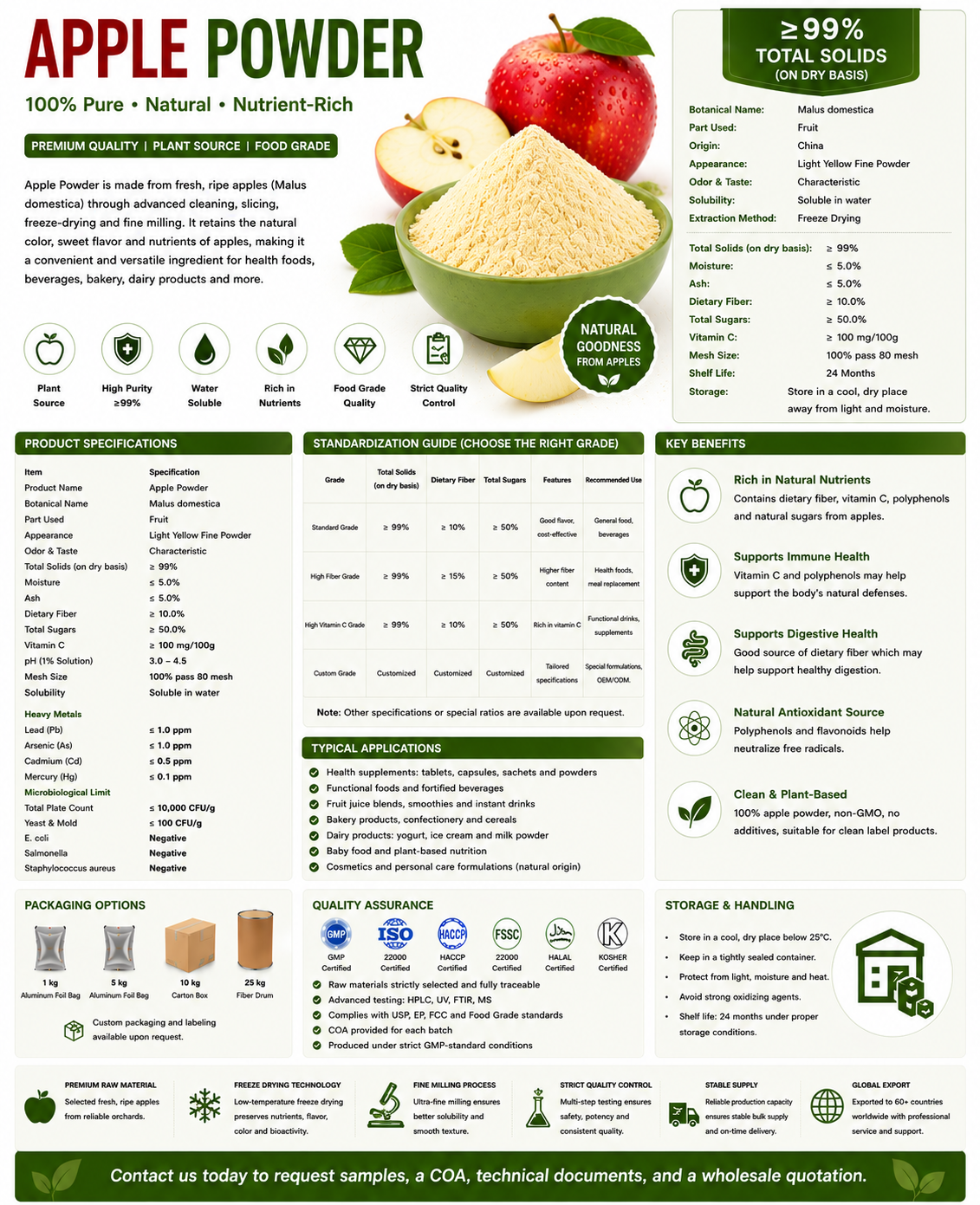
Quality evaluation for apple powder should reflect its nature as a fruit-derived food ingredient. Incoming fruit quality, drying conditions, moisture management, and microbiological control all influence commercial consistency.
Commercial apple powder should be selected according to processing method, fruit composition, physical performance, and intended application rather than an unsupported purity number. Freeze-dried and other processing options provide flexibility for buyers balancing premium sensory characteristics, powder handling, formulation performance, and ingredient cost.
Production under GMP-standard conditions, in-house R&D and testing capabilities, per-batch quality control, stable bulk supply, third-party testing options, global export experience, and standard or customized specifications support professional food, beverage, and nutritional product development.
Standard commercial packaging includes 1 kg and 5 kg aluminum foil bags and 25 kg fiber drums with protective inner packaging. Custom packaging can be arranged according to order volume and downstream production requirements. Because fruit powders can absorb moisture, containers should remain tightly sealed when not in use.
Store apple powder in a cool, dry location protected from direct sunlight, excessive heat, moisture, and strong odors. Under appropriate conditions and in unopened original packaging, a typical commercial shelf life is 24 months.
Apple powder can be incorporated into customized fruit powders, superfood blends, beverage powders, meal-replacement formulations, capsules, tablets, and other nutritional products. OEM and private label services can include ingredient selection, formulation, blending, finished-product manufacturing, labeling, and flexible packaging according to project requirements and applicable target-market guidelines.
Yes. Freeze-drying is commonly selected when minimizing thermal exposure and retaining characteristic fruit sensory qualities are important formulation priorities. Buyers should still evaluate the complete specification, including fruit composition, carrier declaration, moisture, particle characteristics, microbiological limits, and sensory profile rather than selecting solely on the drying-method description.
Apple solids contain naturally occurring sugars that can become sticky and hygroscopic during drying. A suitable carrier can improve drying efficiency, powder flow, resistance to caking, and processing consistency. Buyers should request a clear ingredient composition and select carrier content according to labeling, sensory, processing, and finished-product positioning requirements.
No. Whole apple powder is a complex mixture of naturally occurring fruit components rather than an isolated chemical substance. Buyers should establish what any percentage statement actually represents and evaluate fruit content, carrier composition, processing method, moisture, microbiological quality, sensory properties, and batch documentation when comparing commercial grades.
Review the product specification and batch COA together with processing method, ingredient composition, carrier declaration, appearance, flavor, moisture, particle size, microbiological limits, heavy metals, packaging, and storage requirements. For beverage applications, dispersion and caking behavior should also be evaluated through a formulation sample before commercial scale-up.
Apple powder provides a practical way to incorporate recognizable fruit character and apple solids into beverages, foods, superfood blends, and nutritional products. For professional sourcing, drying method, carrier composition, moisture management, sensory quality, and application performance are more informative than a simple purity claim. Contact us today to request samples, a COA, technical documents, and a wholesale quotation for apple powder.
Packaging & Delivery
| Selling Units: | Kilogram |
|---|
The file is encrypted. Please fill in the following information to continue accessing it


Privacy statement: Your privacy is very important to Us. Our company promises not to disclose your personal information to any external company with out your explicit permission.
Fill in more information so that we can get in touch with you faster
Privacy statement: Your privacy is very important to Us. Our company promises not to disclose your personal information to any external company with out your explicit permission.