

 Contact Now
Send Message
Privacy statement: Your privacy is very important to Us. Our company promises not to disclose your personal information to any external company with out your explicit permission.

Shaanxi Kaishi Biotechnology Co., Ltd


$40
1-199 Kilogram
$35
200-499 Kilogram
$30
≥500 Kilogram


Product Description
Pumpkin Powder 99% is a high-content vegetable powder produced primarily from pumpkin fruit and designed for food, beverage, nutrition, bakery, and supplement formulations. It provides characteristic pumpkin color, flavor, carbohydrates, naturally occurring carotenoids, and plant solids in a convenient dry format suitable for commercial processing and product development.
Pumpkin powder is produced by drying pumpkin fruit material and milling it into a stable powder. Depending on the manufacturing process, commercial grades may be produced by spray drying, freeze drying, hot-air drying, or other controlled dehydration methods. Drying technology affects color, particle structure, solubility, flow, moisture, and retention of naturally occurring compounds.
The “99%” specification refers to a formulation consisting predominantly of pumpkin-derived material rather than a chemically isolated substance with 99% analytical purity. Pumpkin powder is a multi-component food ingredient, so it does not have one universal CAS number, molecular formula, or molecular weight.
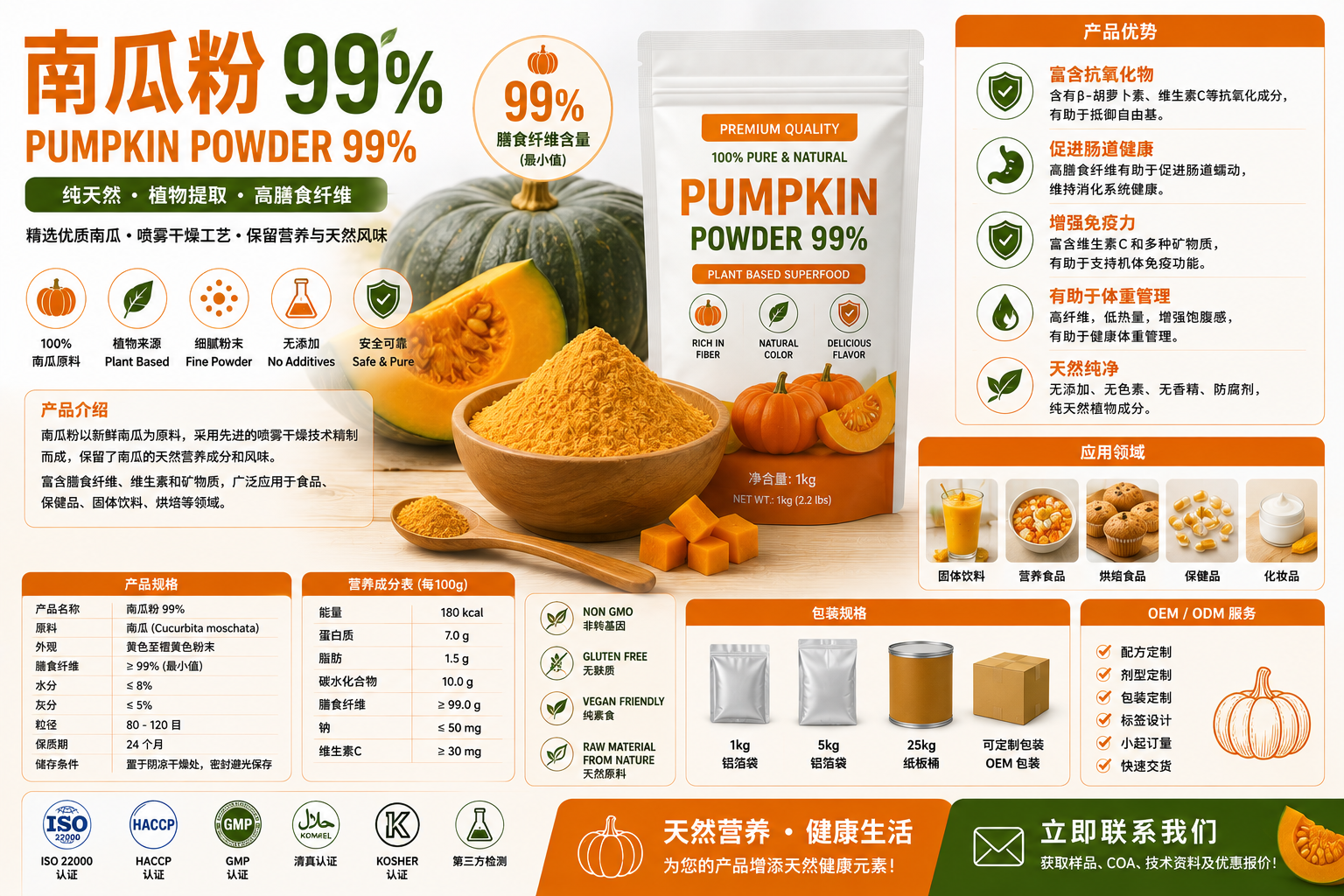
| Item | Specification |
|---|---|
| Product Name | Pumpkin Powder 99% |
| Product Category | Superfood Powder / Vegetable Powder |
| Botanical Source | Cucurbita species fruit |
| Pumpkin Content | 99% pumpkin-derived material |
| Appearance | Fine yellow to orange-yellow powder |
| Flavor and Odor | Characteristic mild pumpkin flavor and aroma |
| CAS Number | Not applicable as a single CAS substance; pumpkin powder is a multi-component food ingredient |
| Molecular Formula | Not applicable; natural multi-component vegetable matrix |
| Molecular Weight | Not applicable; natural multi-component vegetable matrix |
| Identification | Organoleptic evaluation and ingredient-appropriate analytical verification |
| Test Methods | Food ingredient methods appropriate to moisture, microbiological quality, heavy metals, composition, and selected marker compounds where required |
| Particle Size | Fine powder; customizable according to formulation and processing requirements |
| Solubility | Dispersible in water; actual solubility depends on drying method, particle size, and natural pumpkin solids |
| Moisture | Controlled for powder stability and storage performance |
| Natural Components | Carbohydrates, dietary fiber, protein, minerals, and naturally occurring carotenoids |
| Carrier Content | Limited according to the 99% pumpkin-content specification and processing requirements |
| Microbiological Quality | Controlled according to applicable food ingredient specifications |
| Heavy Metals | Controlled according to applicable food ingredient requirements |
| Shelf Life | Typically 24 months in unopened packaging under recommended storage conditions |
| Storage | Store sealed in a cool, dry place away from direct sunlight, heat, and moisture |
| Packaging | 1 kg and 5 kg aluminum foil bags, 25 kg fiber drums, and custom bulk packaging |
| Applications | Bakery, beverages, nutrition powders, soups, noodles, snacks, functional foods, supplements, and vegetable powder blends |
Drying method is the most important technical fingerprint when evaluating pumpkin powder because it can change color, particle size, porosity, flowability, hydration, solubility, and retention of naturally occurring bioactive compounds. Research comparing multiple drying systems has shown measurable differences in these physical and compositional characteristics. :contentReference[oaicite:0]{index=0}
| Drying Method | Typical Strength | Buyer Consideration |
|---|---|---|
| Freeze Drying | Strong color and bioactive-compound retention | Useful for premium formulations where sensory quality and gentle processing are prioritized |
| Spray Drying | Scalable production and good powder dispersibility | Review carrier level, inlet temperature, solubility, and fruit-solid content |
| Hot-Air Drying | Commercially practical and cost-efficient | Drying temperature can influence color and retention of heat-sensitive compounds |
| Microwave-Convective Drying | Can shorten drying time while maintaining useful physicochemical properties | Evaluate bulk density, flow, color, and formulation behavior for the intended application |
Recent work also found that freeze-dried pumpkin powder showed smaller particle size, color closer to the fresh material, and stronger adsorption and solubility characteristics than hot-air- and heat-pump-dried samples, while the latter offered different flow and filling properties. :contentReference[oaicite:1]{index=1}
| Selection Factor | 99% Pumpkin Powder | Standard Carrier-Based Powder |
|---|---|---|
| Pumpkin Content | High pumpkin-derived material content | May contain a higher proportion of carrier depending on processing needs |
| Label Positioning | Suitable where high vegetable content is important | Suitable where processing performance and cost balance are priorities |
| Drying Behavior | Requires careful control of natural sugars and solids | Carriers can improve powder formation and handling |
| Flavor and Color | Selected for stronger pumpkin identity | Depends on pumpkin concentration and processing conditions |
| Formulation Priority | High pumpkin-solids positioning | Processing efficiency and formulation flexibility |
Pumpkin contains natural carbohydrates and other solids that can affect drying, stickiness, hygroscopicity, and powder flow. Some spray-dried products therefore use carrier materials to improve process efficiency and physical stability. For a 99% pumpkin powder, buyers should verify the declared pumpkin proportion together with dispersibility, moisture, and handling performance rather than comparing the percentage alone.
Pumpkin powder can be used across both sweet and savory product systems. The optimal addition level depends on desired pumpkin intensity, color, texture, moisture balance, nutritional positioning, and the processing conditions of the finished product.
| Application | Specification Priority | Why It Matters |
|---|---|---|
| Instant Beverages | Dispersibility and particle size | These characteristics influence mixing, sedimentation, and mouthfeel. |
| Bakery Products | Color, moisture, and water absorption | Pumpkin powder can influence dough hydration, product color, and finished texture. |
| Noodles and Pasta | Particle size, color, and water absorption | Pumpkin powder can alter cooking behavior, texture, and visual appearance. |
| Superfood Blends | Pumpkin content and carrier declaration | These factors influence ingredient positioning and label formulation. |
| Nutrition Powders | Flavor, flowability, and bulk density | Physical properties affect blending, filling, serving consistency, and sensory performance. |
| Premium Vegetable Products | Drying method and color retention | Gentler drying may be preferred when visual quality and retention of naturally occurring compounds are priorities. |
Pumpkin powder has demonstrated practical use in flour-based foods. Research on noodle formulations found that increasing pumpkin powder changed color, water absorption, cooking characteristics, hardness, and elasticity, illustrating why application testing is important when replacing part of a cereal base with vegetable powder. :contentReference[oaicite:2]{index=2}
Pumpkin powder should be assessed as a whole-food vegetable ingredient rather than using the purity framework applied to isolated compounds. Commercial quality control should combine raw-material identity with physical, microbiological, compositional, and contaminant specifications.
For commercial buyers, the most useful pumpkin powder specification combines high pumpkin content with consistent color, sensory profile, moisture control, particle size, and processing performance. Drying method should also be considered because it can materially influence how the ingredient behaves in a finished formulation.
Standard bulk packaging includes 1 kg and 5 kg aluminum foil bags and 25 kg fiber drums, with customized packaging available for commercial requirements. Packages should remain tightly sealed because vegetable powders can absorb environmental moisture, which may affect flowability, color, and storage performance.
OEM and private-label services can support customized vegetable powder blends, superfood formulations, nutrition powders, functional drink mixes, bakery premixes, meal replacements, and finished packaged products. Pumpkin powder can also be combined with other fruit, vegetable, protein, or Nutritional Ingredients according to product positioning and formulation requirements.
The 99% specification refers to a product composed predominantly of pumpkin-derived material rather than a single pumpkin compound at 99% chemical purity. Because pumpkin powder contains carbohydrates, fiber, protein, pigments, minerals, and other natural components, buyers should review pumpkin content together with carrier declaration, moisture, particle size, and processing method.
No. Pumpkin powder contains natural plant solids and fiber, so it is better described as dispersible rather than completely soluble. Solubility and suspension behavior depend on drying method, particle size, concentration, and processing. A beverage application should therefore be evaluated for mouthfeel and sedimentation instead of relying only on a general solubility statement.
There is no single best method for every application. Freeze drying may be preferred when color and gentle processing are priorities, while spray drying is commonly selected for scalable powder production and dispersibility. Hot-air and combined drying methods offer different cost and physical-performance profiles, so selection should follow the intended finished product. :contentReference[oaicite:3]{index=3}
Yes. Pumpkin powder can be incorporated into bakery, flour, noodle, and pasta systems, but it can change water absorption, color, texture, and processing behavior. Formulators should therefore adjust hydration and replacement level during development rather than treating pumpkin powder as a one-to-one substitute for wheat flour. :contentReference[oaicite:4]{index=4}
Store the powder tightly sealed in a cool, dry place away from direct sunlight, high temperatures, and moisture. Under suitable packaging and recommended storage conditions, a shelf life of approximately 24 months is common. Protecting the powder from humidity is especially important for maintaining flow, color, and handling characteristics.
Pumpkin Powder 99% is a high-content vegetable ingredient for food, beverage, nutrition, and supplement manufacturers seeking convenient pumpkin solids in dry form. Buyers should compare not only pumpkin percentage but also drying method, carrier content, particle size, color, dispersibility, moisture, sensory performance, and application-specific processing behavior.
Contact us today to request samples, a COA, technical documents, and a wholesale quotation for Pumpkin Powder 99%.

Packaging & Delivery
| Selling Units: | Kilogram |
|---|
The file is encrypted. Please fill in the following information to continue accessing it


Privacy statement: Your privacy is very important to Us. Our company promises not to disclose your personal information to any external company with out your explicit permission.
Fill in more information so that we can get in touch with you faster
Privacy statement: Your privacy is very important to Us. Our company promises not to disclose your personal information to any external company with out your explicit permission.