

 Contact Now
Send Message
Privacy statement: Your privacy is very important to Us. Our company promises not to disclose your personal information to any external company with out your explicit permission.

Shaanxi Kaishi Biotechnology Co., Ltd


$2.2
1-499 Bag/Bags
$1.8
500-999 Bag/Bags
$1.5
≥1000 Bag/Bags


Product Description
Gummy supplement contract manufacturing is a turnkey production service for brands developing chewable nutritional supplements in customized formulas, flavors, colors, shapes, and packaging formats. It supports vitamins, minerals, botanical ingredients, and other suitable functional ingredients, helping supplement brands move from formulation and sampling to scalable finished-product production.
Gummies combine consumer-friendly delivery with flexible product positioning, but successful manufacturing requires more than choosing active ingredients. The formula must balance active dosage, gummy base, flavor, texture, moisture, processing temperature, and stability. Professional formulation and production control are therefore important when converting a supplement concept into a commercially viable gummy product.
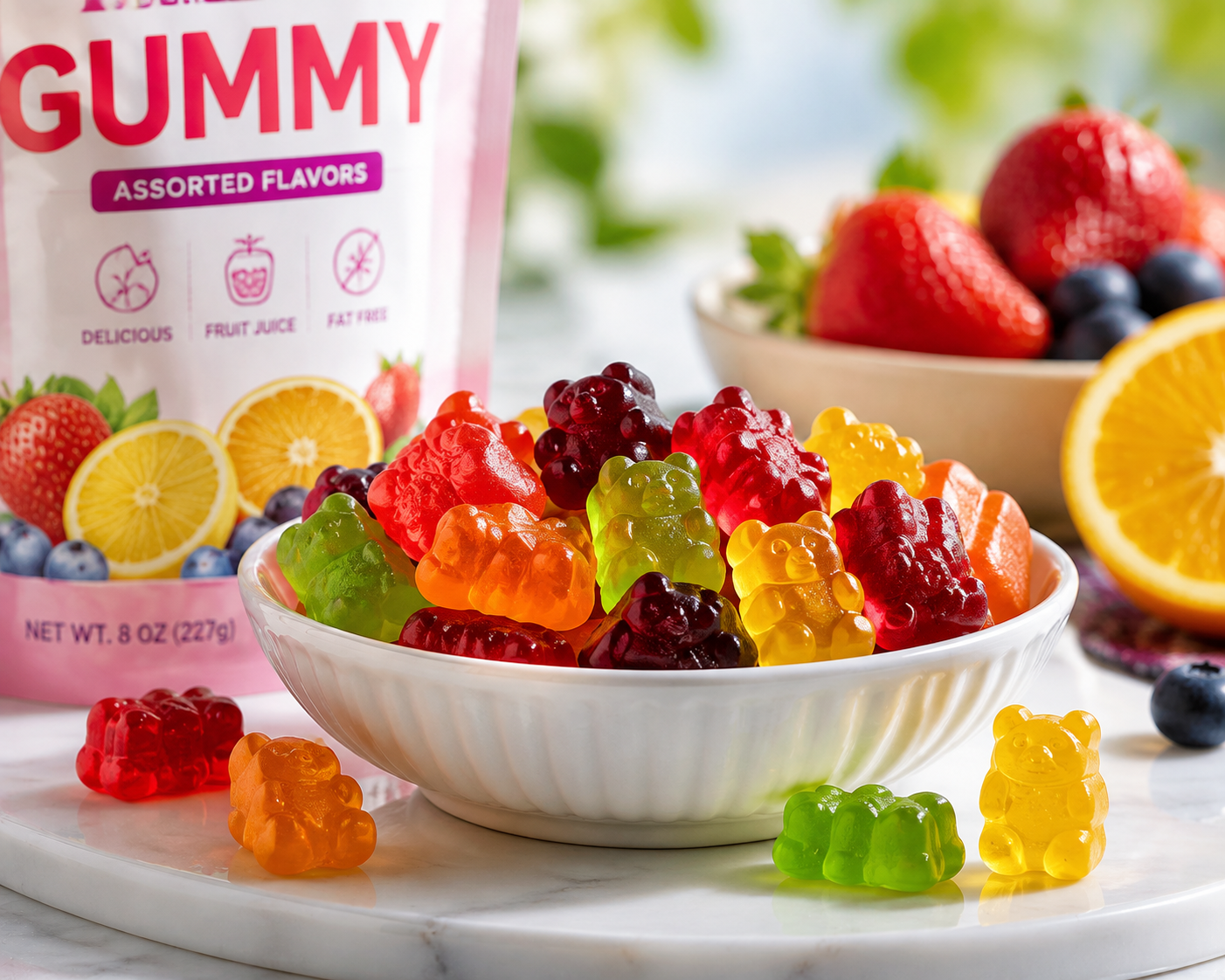
| Item | Specification |
|---|---|
| Service Type | Gummy supplement contract manufacturing and private label |
| Dosage Form | Chewable gummies |
| Gummy Base | Pectin-based or gelatin-based formulations |
| Active Ingredients | Vitamins, selected minerals, botanical extracts, Nutritional Ingredients, and compatible functional ingredients |
| Formula Type | Single-active and multi-ingredient formulations |
| Flavor | Fruit and other customized flavor profiles |
| Color | Natural and conventional coloring options according to formulation requirements |
| Sweetening System | Conventional or customized sweetening systems according to product positioning and formulation feasibility |
| Shape and Size | Standard gummy formats and customized options according to project requirements |
| Active Testing | Ingredient-appropriate analytical methods such as HPLC, UV, or other validated methods |
| Quality Testing | Identity, active content, heavy metals, microbiological parameters, moisture, and other applicable finished-product specifications |
| Packaging | Bottles, jars, pouches, bulk packaging, and customized retail packaging |
| Labeling | Private-label and customized labeling supported |
| MOQ | Flexible commercial quantities according to formula, mold, packaging, and customization requirements |
| Shelf Life | Commonly up to 24 months when formulation, packaging, and storage conditions are suitable |
| Storage | Store in a cool, dry place away from direct sunlight, excessive heat, and moisture |
| Documentation | COA, TDS, SDS, and relevant technical documentation available for commercial projects |
Gummy manufacturing can support both new product development and the conversion of an existing supplement concept into a chewable format. Development normally considers the target active amount per serving, ingredient compatibility, gummy base, flavor masking, texture, processing behavior, stability, and final packaging before commercial-scale production.
The most important sourcing decision in a gummy project is not simply which active ingredients to include. Buyers should first determine whether the required active dose can be delivered while maintaining acceptable texture, taste, stability, and serving size. A formula that works well in capsules does not automatically translate into gummies.
| Formulation Requirement | Key Consideration | Practical Selection Logic |
|---|---|---|
| High Active Load | Gummy weight, texture, flavor, and processing limits | Evaluate active concentration and serving count before fixing the final gummy size. |
| Botanical Extracts | Bitterness, color, odor, and extract concentration | Use concentrated extracts where appropriate and develop the flavor system around the sensory profile of the botanical. |
| Mineral Formulas | Bulk density, taste, compatibility, and achievable dose | Select mineral forms with consideration for both nutritional targets and gummy processing characteristics. |
| Pectin Gummies | Gel structure, acidity, processing conditions, and texture | Often selected for plant-based positioning, subject to compatibility with the complete formula. |
| Gelatin Gummies | Elastic texture and formulation requirements | Suitable when a traditional chewy gummy texture and animal-derived gelatin are acceptable for the target market. |
| Heat-Sensitive Ingredients | Processing exposure and active stability | Review ingredient stability during formulation rather than assuming every active is suitable for conventional gummy processing. |
| Sugar and Sweetener Strategy | Taste, texture, water activity, and product positioning | Develop the sweetening system together with the gummy matrix because changing sweeteners can affect more than sweetness alone. |
Gummies have a finite physical capacity for active ingredients. High-dose powders can affect viscosity, setting behavior, mouthfeel, taste, and finished-piece weight. For this reason, the target amount per serving should be evaluated early. Concentrated ingredients or multiple gummies per serving may be more practical than forcing excessive active material into one piece.
Botanical extracts, minerals, Amino Acids, and other functional ingredients may contribute bitterness, acidity, odor, or characteristic aftertaste. Flavor development should therefore occur alongside active-dose development. Acidity, sweetness, aroma, and flavor selection can be adjusted as a system instead of treating flavor as a final cosmetic addition.
Custom gummy manufacturing is suitable for a broad range of consumer supplement concepts when the selected ingredients are compatible with the dosage form. Typical commercial applications include:
Gummy projects can be developed from an original concept, an existing formula, or a target ingredient list. OEM and private-label services can cover formulation adjustment, raw-material selection, flavor development, trial sampling, commercial production, packaging, and labeling. Existing formulations can also be adapted where ingredient compatibility or processing requirements make modification necessary.
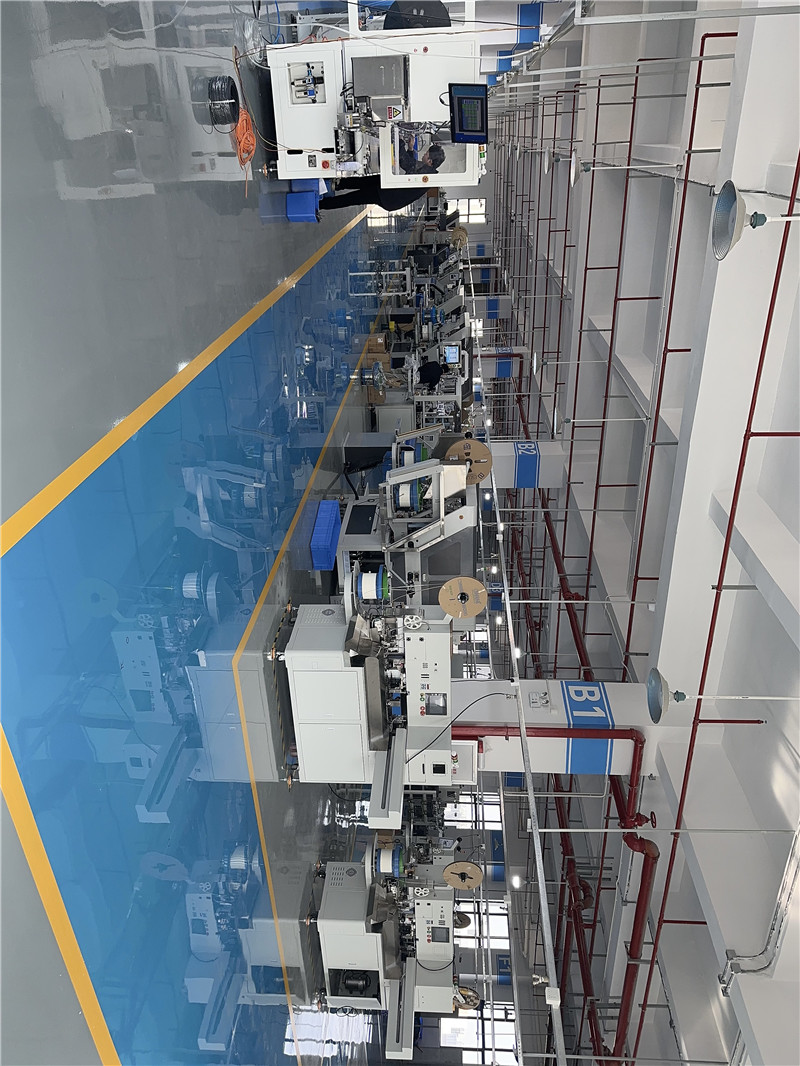
Finished gummy quality depends on both raw-material control and process consistency. Production under GMP-standard conditions is supported by R&D and analytical testing capabilities. Quality parameters are selected according to the formula and intended specification, with testing applied to incoming ingredients and finished products as appropriate.
A well-designed gummy project connects formulation feasibility with commercial requirements from the beginning. Instead of treating the active formula, flavor system, gummy base, and packaging as separate decisions, an integrated development process helps identify compatibility and processing issues before scale-up.
Finished gummies can be packed in bottles, jars, resealable pouches, or suitable bulk formats. Packaging format, fill count, label design, and outer cartons can be customized according to product positioning and distribution requirements. Moisture and temperature protection should be considered when selecting packaging because gummy texture and stability are sensitive to storage conditions.
A useful development brief includes the target active ingredients, desired amount per serving, serving size, gummy base preference, flavor direction, sweetening requirements, target market, and packaging format. Providing these details early helps determine whether the concept is technically suitable for gummy processing and where formulation adjustments may be necessary.
MOQ depends on formulation complexity, ingredient sourcing, mold requirements, flavor and color customization, packaging components, and production setup. Standardized projects generally provide more flexibility, while highly customized formulas or packaging can require larger commercial runs. Bulk and OEM quantities can therefore be structured around the specific project rather than one universal MOQ.
Many botanical extracts can be incorporated into gummies, but suitability depends on dose, solubility or dispersibility, bitterness, color, stability, and processing behavior. Concentrated Standardized Extracts can be useful when space is limited. The complete formula should be evaluated because an ingredient suitable for capsules may require adjustment for a gummy matrix.
Commercial projects can be supported with standard technical documentation such as a Certificate of Analysis, Technical Data Sheet, and Safety Data Sheet where applicable. Testing can cover identity, active content, heavy metals, microbiological parameters, moisture, and other formula-specific requirements. Target-market labeling and claims should be reviewed against applicable regulatory guidelines.
Gummies should generally be kept in a cool, dry environment away from direct sunlight, excessive heat, and moisture. Suitable moisture-protective packaging helps preserve texture and product quality. A shelf life of up to 24 months is common for appropriately formulated and packaged products, although stability ultimately depends on the specific formula and packaging system.
Gummy manufacturing requires coordinated decisions across active dosage, ingredient compatibility, flavor, texture, processing, testing, and packaging. A formulation-led development process helps create a product that is practical to manufacture at commercial scale while meeting the intended positioning and quality requirements.
Contact us today to request samples, technical documents, custom formulation support, and a wholesale quotation for gummy supplement manufacturing.
Packaging & Delivery
| Selling Units: | Bag/Bags |
|---|
The file is encrypted. Please fill in the following information to continue accessing it


Privacy statement: Your privacy is very important to Us. Our company promises not to disclose your personal information to any external company with out your explicit permission.
Fill in more information so that we can get in touch with you faster
Privacy statement: Your privacy is very important to Us. Our company promises not to disclose your personal information to any external company with out your explicit permission.