


 Contact Now
Send Message
Privacy statement: Your privacy is very important to Us. Our company promises not to disclose your personal information to any external company with out your explicit permission.

Shaanxi Kaishi Biotechnology Co., Ltd


Product Description
Corn Protein Peptide is a plant-derived peptide ingredient produced by enzymatic hydrolysis of corn protein, providing short-chain peptides and Amino Acids for nutritional and functional formulations. It is primarily used in dietary supplements, functional foods, beverages, nutrition powders, and other applications seeking a plant-based protein-derived peptide ingredient.
Corn protein is naturally rich in several amino acids, while enzymatic hydrolysis breaks larger proteins into smaller peptide fractions. Because Corn Protein Peptide is a mixture rather than a single defined molecule, commercial specifications are normally based on protein content, peptide characteristics, moisture, microbiological quality, and other application-specific parameters.
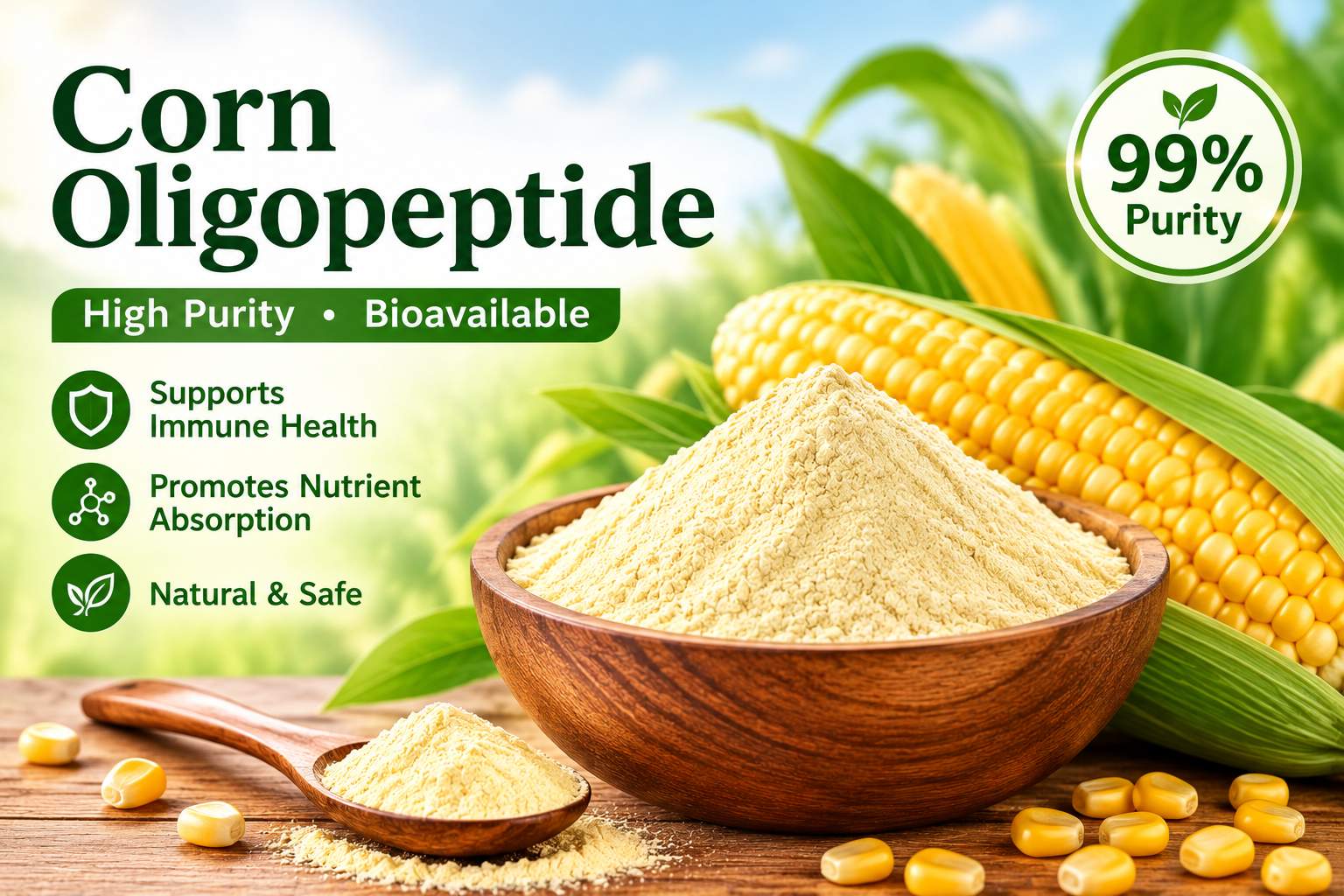
Corn Protein Peptide is obtained from corn-derived protein through controlled enzymatic hydrolysis. The process reduces the molecular size of the original protein and produces a mixture containing peptides of different chain lengths together with free amino acids.
Unlike a single purified chemical compound, Corn Protein Peptide does not have one universal CAS number, molecular formula, or molecular weight. Its exact peptide profile depends on the corn protein source, hydrolysis process, enzyme system, and degree of hydrolysis. For B2B procurement, these process-related characteristics are therefore more useful than a single molecular formula.
| Item | Specification |
|---|---|
| Product Name | Corn Protein Peptide |
| Ingredient Category | Plant-derived nutritional peptide ingredient |
| Source | Corn protein |
| Production Method | Controlled enzymatic hydrolysis of corn protein |
| CAS Number | Not applicable as a single CAS number; this is a peptide mixture |
| Molecular Formula | Not applicable as a single formula; composition varies across peptide fractions |
| Molecular Weight | Variable; determined by the peptide distribution and hydrolysis process |
| Protein Content | Specified according to the commercial grade and application requirements |
| Peptide Profile | Mixture of peptides and free amino acids; distribution depends on hydrolysis conditions |
| Test Methods | Protein and peptide characterization methods selected according to the specification; HPLC or other analytical methods may be used where appropriate |
| Appearance | Light yellow to yellow fine powder, depending on processing |
| Odor | Characteristic mild protein or corn-derived odor |
| Form | Fine powder |
| Solubility | Water-dispersible or water-soluble depending on peptide profile and processing |
| Particle Size | Customizable according to formulation and processing requirements |
| Shelf Life | Typically 24 months when properly stored |
| Storage | Store in a cool, dry place, tightly sealed and protected from heat, moisture, and direct sunlight |
| Standard Packaging | 1 kg or 5 kg aluminum foil bag; 25 kg fiber drum; custom packaging available |
| Bulk Supply | Available for commercial and formulation-scale requirements |
| Documentation | COA, TDS, SDS, and supporting technical documentation available as applicable |
Corn Protein Peptide can be incorporated into nutritional and food formulations where a plant-derived peptide ingredient is appropriate, subject to the requirements of the finished product and target market.
The key sourcing issue for Corn Protein Peptide is that peptide quality cannot be fully described by protein percentage alone. Formulators should evaluate the source protein, hydrolysis process, peptide distribution, solubility, sensory characteristics, and analytical specification together.
| Buyer Consideration | Why It Matters | What to Check |
|---|---|---|
| Protein content | Defines the overall protein-derived material available in the ingredient | Confirm the assay method and minimum specification stated on the COA |
| Peptide distribution | Influences dissolution, sensory properties, and formulation behavior | Request available peptide-size or molecular-weight distribution data when it is important to the application |
| Degree of hydrolysis | Provides information about how extensively the original protein has been broken down | Match the hydrolysis profile to the intended formulation rather than selecting solely by total protein content |
| Solubility and dispersion | Important for beverages, powders, and instant nutritional systems | Evaluate performance in the actual formulation matrix and processing conditions |
| Sensory profile | Peptide hydrolysis can affect taste and odor | Conduct application-specific sensory testing before large-scale commercialization |
For this reason, a procurement specification should describe more than a generic "corn protein" identity. A suitable technical package should clearly distinguish the peptide ingredient from intact corn protein and document the analytical parameters that are relevant to the intended formulation.
Corn Protein Peptide is a heterogeneous ingredient, so its performance depends on the peptide distribution and processing conditions. In beverage and powder applications, formulators should assess dissolution, dispersion, sedimentation, flavor, and compatibility with other ingredients in the final matrix.
For nutritional formulations, the amino acid and peptide profile should be considered together with the overall protein contribution of the finished product. Where a specific peptide size range or degree of hydrolysis is important, that parameter should be incorporated into the purchasing specification and verified through appropriate analytical documentation.
Standard commercial packaging commonly includes 1 kg or 5 kg aluminum foil bags and 25 kg fiber drums. Custom packaging, labeling, and packing configurations can be arranged according to order requirements and product handling needs.
Corn Protein Peptide can be incorporated into customized nutritional products, including powder blends, capsules, tablets, beverages, and other suitable finished-product formats. OEM and ODM support may include formulation development, dosage-form production, private labeling, and customized packaging.
Particle size, packaging format, peptide specification, and finished-product configuration can be adapted to the intended manufacturing process and target-market requirements.
Quality control for Corn Protein Peptide should address both the identity of the corn-derived protein material and the characteristics of the hydrolyzed peptide ingredient. Typical batch-release controls include:
Technical documentation such as COA, TDS, and SDS can support incoming inspection, formulation development, and regulatory review. Final product claims and labeling should be assessed against the requirements of the destination market.
No. Corn protein is the original protein material, while Corn Protein Peptide is produced by enzymatic hydrolysis that breaks the protein into smaller peptide fractions and free amino acids. Their functional properties, solubility, sensory profile, and formulation behavior can therefore differ.
No single CAS number universally represents Corn Protein Peptide because it is a mixture of peptides rather than one defined chemical compound. Its composition depends on the source protein and hydrolysis process, so commercial quality is normally described through analytical specifications rather than one molecular formula or molecular weight.
Buyers should review the source, protein content, peptide characteristics, hydrolysis profile, appearance, solubility, microbiological limits, heavy metals, moisture, and relevant analytical methods. If a particular peptide-size range or degree of hydrolysis is required, that parameter should be explicitly included in the technical specification and supporting documentation.
Corn Protein Peptide is a plant-derived nutritional peptide ingredient produced through enzymatic hydrolysis of corn protein. Its main B2B value lies in providing a corn-based peptide material with configurable quality characteristics for nutritional, food, beverage, and formulation applications. Procurement decisions should focus on peptide profile and application performance rather than protein percentage alone.
Contact us today to request samples, a COA, technical documents, and a wholesale quotation for Corn Protein Peptide.
Packaging & Delivery
The file is encrypted. Please fill in the following information to continue accessing it


Privacy statement: Your privacy is very important to Us. Our company promises not to disclose your personal information to any external company with out your explicit permission.
Fill in more information so that we can get in touch with you faster
Privacy statement: Your privacy is very important to Us. Our company promises not to disclose your personal information to any external company with out your explicit permission.