


 Contact Now
Send Message
Privacy statement: Your privacy is very important to Us. Our company promises not to disclose your personal information to any external company with out your explicit permission.

Shaanxi Kaishi Biotechnology Co., Ltd


Product Description
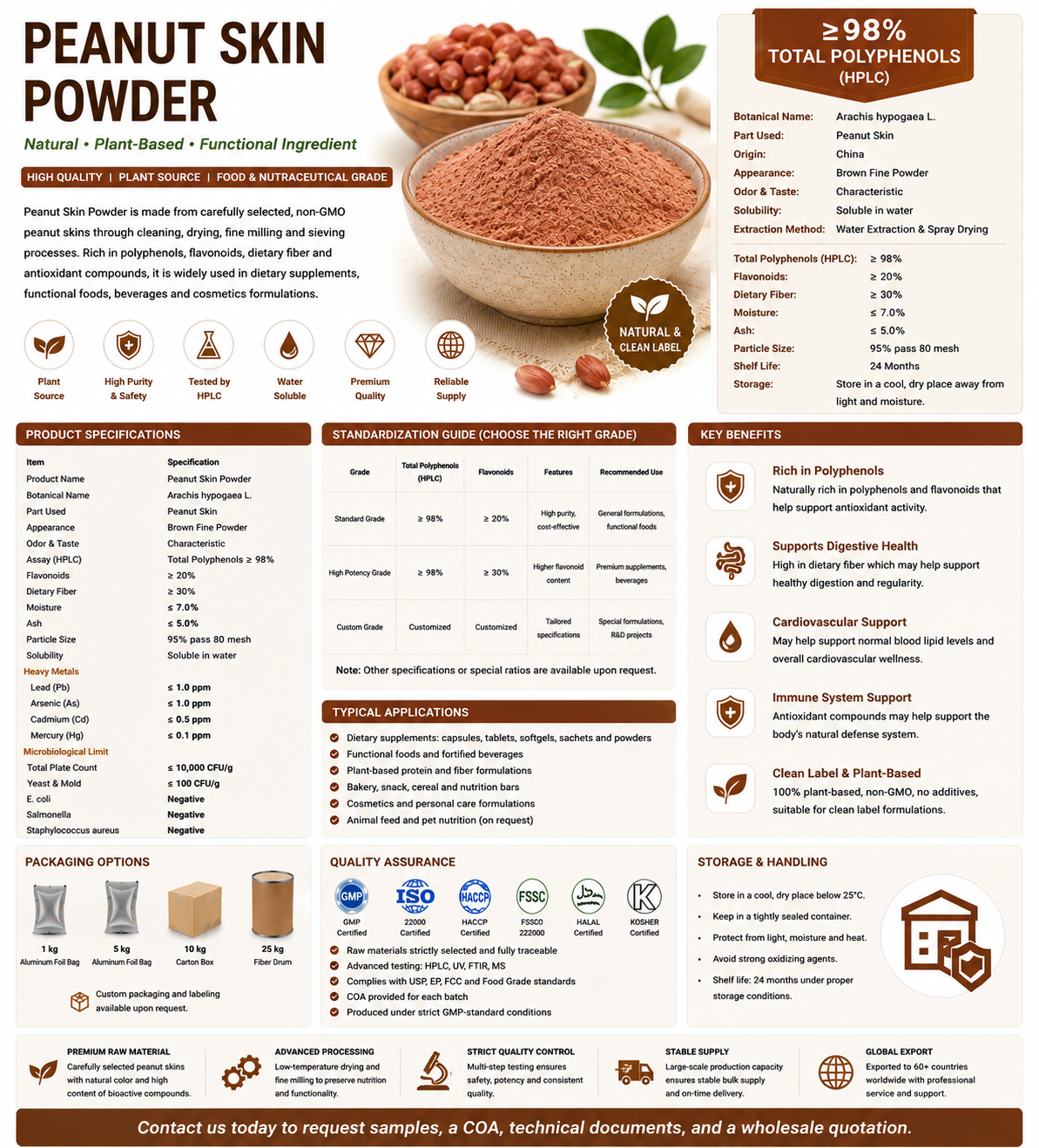
Peanut Skin Powder is a finely processed botanical powder made from the reddish seed coats of peanuts, naturally containing polyphenols, proanthocyanidins, and related phenolic compounds. It is primarily used in functional food, nutritional ingredient, antioxidant-focused, and research formulations where manufacturers want a plant-derived peanut skin ingredient in convenient powdered form.
Peanut skins are a natural by-product of peanut processing and contain substantially different constituents from the peanut kernel itself. For B2B formulation, buyers can source whole peanut skin powder or more concentrated peanut skin extracts depending on the desired polyphenol concentration, formulation cost, color, flavor, and finished-product positioning.
| Item | Specification |
|---|---|
| Product Name | Peanut Skin Powder |
| Botanical Source | Arachis hypogaea L. |
| Plant Part | Seed coat / peanut skin |
| Product Type | Botanical food ingredient powder |
| CAS Number | Not applicable to whole peanut skin powder as a multi-component botanical material |
| Molecular Formula | Not applicable to a multi-component botanical material |
| Molecular Weight | Not applicable to a multi-component botanical material |
| Appearance | Fine reddish-brown to brown powder |
| Typical Grades | Whole peanut skin powder and customized botanical powder specifications |
| Key Native Constituents | Polyphenols, proanthocyanidins, flavonoids, and other naturally occurring phenolic compounds |
| Identity Testing | Botanical identification with appropriate physicochemical testing |
| Polyphenol Testing | Colorimetric or chromatographic methods according to the required specification |
| Particle Size | Customizable according to food processing and formulation requirements |
| Quality Parameters | Identity, moisture, heavy metals, microbiological limits, and relevant compositional parameters |
| Allergen Status | Peanut-derived material; allergen control and appropriate labeling are essential |
| Shelf Life | Typically 24 months when properly sealed and stored |
| Storage | Store in a cool, dry place away from direct sunlight, heat, and moisture |
| Standard Packaging | 1 kg or 5 kg aluminum foil bag; 25 kg fiber drum; custom packaging supported |
| Applications | Functional foods, nutritional powders, botanical formulations, food ingredient development, and research applications |
The most important sourcing decision for this ingredient is whether the formulation actually requires whole peanut skin powder or a standardized peanut skin extract. These materials should not be treated as interchangeable. Whole powder retains the broader natural matrix of the peanut skin, while extraction can concentrate selected soluble constituents such as polyphenols.
| Selection | Key Consideration | Typical Fit |
|---|---|---|
| Whole Peanut Skin Powder | Less processed botanical matrix with naturally occurring phenolic constituents; composition can vary with raw material and processing | Whole-food concepts, functional food development, botanical blends, and cost-sensitive formulations |
| Peanut Skin Extract | More concentrated composition and better suited to defined marker specifications when standardized accordingly | Concentrated nutritional formulas and products requiring controlled polyphenol specifications |
| Customized Fine Powder | Particle size can be adjusted to improve dispersion and processing behavior for the intended dosage form | Powder blends, sachets, premixes, and selected food systems |
For procurement teams, a higher concentration is not automatically the better choice. Whole powder may fit products emphasizing minimally processed botanical ingredients, while an extract is usually more appropriate when the formulation requires a defined concentration of selected phytochemicals. Buyers should therefore establish the intended label positioning and analytical specification before selecting the material.
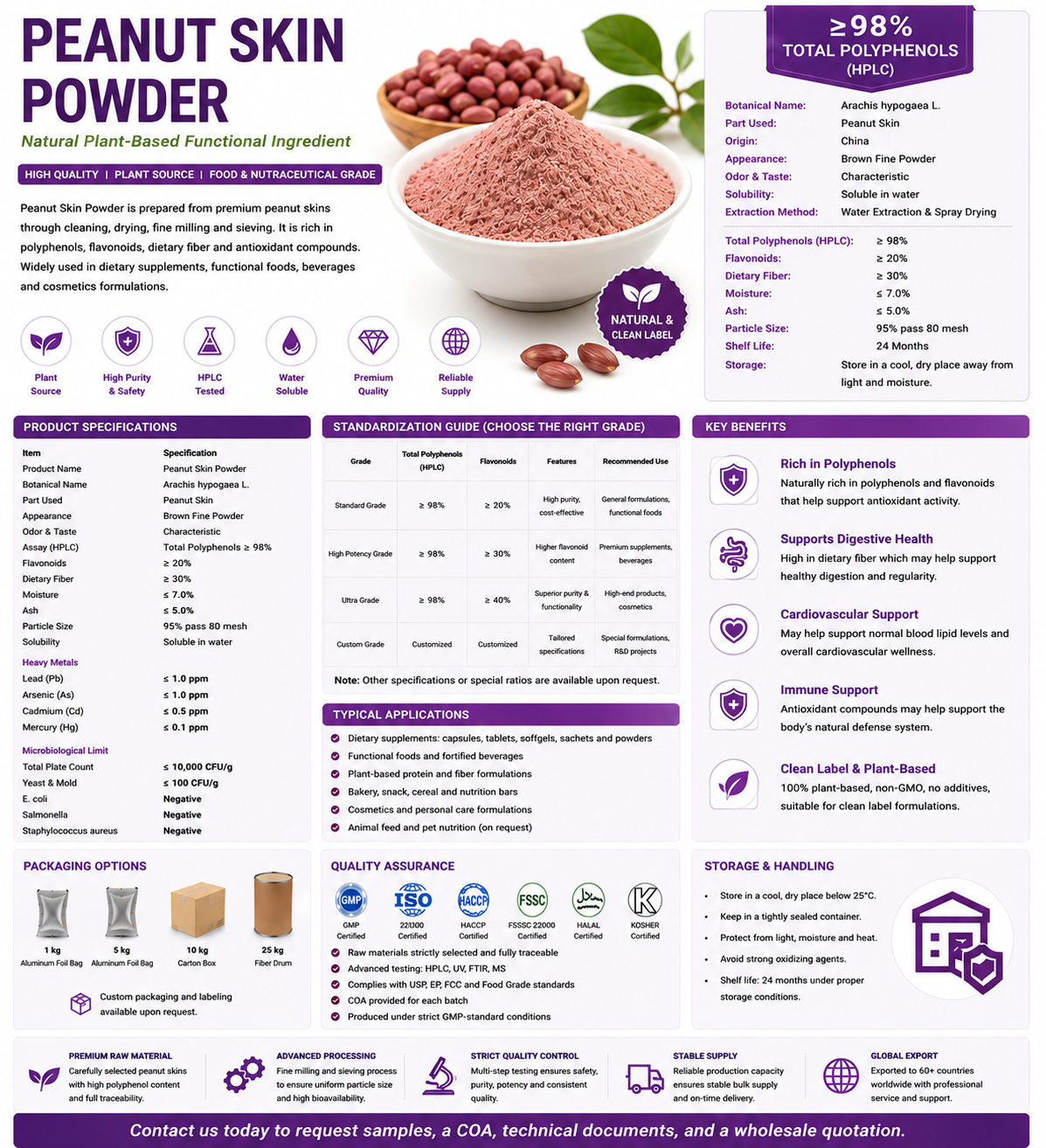
Peanut Skin Powder can be evaluated for functional food formulations seeking naturally occurring plant polyphenols and a recognizable botanical source. Its reddish-brown color and characteristic sensory profile should be considered during formulation, particularly in light-colored or delicately flavored finished products.
The powder can be incorporated into selected nutritional blends, sachets, and botanical powder products. Fine particle specifications may support more uniform blending, although formulators should evaluate dispersion, flavor, color, and compatibility within the complete finished-product matrix.
Peanut skin contains phenolic constituents that have been studied for antioxidant activity. For commercial products requiring a defined polyphenol claim or marker specification, buyers should consider whether a standardized peanut skin extract is more suitable than an unstandardized whole powder.
Peanut Skin Powder is also relevant to research and product-development projects exploring value-added uses for peanut processing materials, natural polyphenol sources, food formulation, and botanical ingredient applications.
Peanut Skin Powder has characteristics that should be evaluated before scale-up. Its natural reddish-brown pigmentation can influence finished-product appearance, while native phenolic compounds may contribute astringency or characteristic flavor. These properties may be acceptable or desirable in darker food systems but require more careful formulation in neutral-colored products.
Because Peanut Skin Powder is directly derived from peanuts, allergen management is a fundamental sourcing consideration rather than an optional quality attribute. Procurement teams should evaluate supplier allergen documentation, production controls, packaging identification, storage procedures, and applicable labeling requirements before introducing the ingredient into commercial manufacturing.
Manufacturers should also assess cross-contact implications for other products handled on shared equipment. Final allergen declarations and labeling must follow applicable regulations in the intended sales market. A peanut-derived botanical ingredient should not be marketed or handled as though its botanical origin removes the need for peanut allergen controls.
Botanical powders require controls that address both raw-material identity and finished ingredient safety. Testing programs should be aligned with the intended food or nutritional application and the specification agreed for the material.
Peanut Skin Powder combines a recognizable botanical source with naturally occurring phenolic compounds and flexible formulation possibilities. For commercial buyers, the key is matching the processing level, particle characteristics, compositional specification, and allergen documentation to the finished product rather than purchasing solely on the basis of powder appearance or price.
Common bulk packaging includes 1 kg and 5 kg aluminum foil bags and 25 kg fiber drums, with customized packaging supported for commercial projects. Keep Peanut Skin Powder tightly sealed in a cool, dry environment away from direct sunlight, excessive heat, and moisture. A typical shelf life is 24 months under appropriate storage conditions.
Peanut Skin Powder can be supplied for bulk ingredient purchasing or incorporated into customized formulation projects. OEM and ODM options include botanical powder blends, custom formulations, finished nutritional products, labeling, private-label services, and flexible packaging. Project quantities and ingredient specifications can be adapted to commercial formulation requirements.
Start with the finished application rather than selecting only by price or particle size. Whole powder suits formulations seeking the broader peanut skin matrix, while Standardized Extracts are more appropriate when controlled polyphenol content is important. Buyers should also define microbiological, heavy-metal, sensory, particle-size, and allergen documentation requirements.
Peanut Skin Powder is a peanut-derived ingredient, so allergen management must be treated as a core procurement and formulation requirement. Buyers should obtain appropriate allergen documentation and evaluate labeling, segregation, cross-contact controls, and manufacturing procedures according to the requirements of the target market and finished-product facility.
Commercial buyers should review the batch COA together with the product specification or TDS, SDS, allergen information, and relevant quality documentation. Depending on the application, incoming specifications may cover identity, moisture, microbiological limits, heavy metals, particle characteristics, and selected compositional or polyphenol parameters.
Particle size can be adapted to different formulation and processing requirements. Finer material may improve blending uniformity in powder systems, but particle size alone does not determine finished-product performance. Formulators should evaluate dispersion, color, sensory characteristics, moisture behavior, and processing compatibility in the complete product.
Peanut Skin Powder offers food, nutrition, and botanical product developers a practical way to formulate with the naturally occurring constituents of peanut skins. Successful sourcing depends on choosing between whole powder and concentrated extract, establishing suitable quality specifications, and addressing peanut allergen controls throughout procurement and manufacturing.
Contact us today to request samples, a COA, technical documents, and a wholesale quotation for Peanut Skin Powder.
Packaging & Delivery
| Selling Units: | Kilogram |
|---|
The file is encrypted. Please fill in the following information to continue accessing it


Privacy statement: Your privacy is very important to Us. Our company promises not to disclose your personal information to any external company with out your explicit permission.
Fill in more information so that we can get in touch with you faster
Privacy statement: Your privacy is very important to Us. Our company promises not to disclose your personal information to any external company with out your explicit permission.